The EUR-1 Certificate of Origin is a document that confirms the origin of goods from the European Union (EU) and is an important tool for businesses engaged in international trade. It allows traders to receive benefits when importing and exporting goods to countries with which the EU has free trade agreements.
The EUR-1 certificate can only be issued for goods produced in the EU or containing materials produced in the EU. The purpose of the certificate is to establish the customs value of the goods and to avoid double taxation. The EUR-1 certificate confirms that the goods meet all the requirements for goods exported from the EU. The EUR-1 certificate has several advantages for companies engaged in international trade.
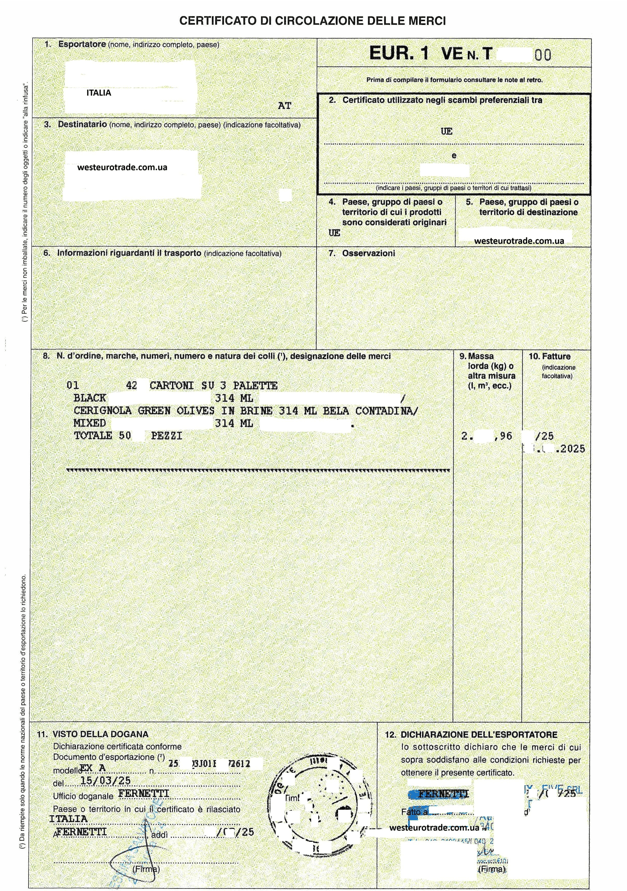
One important aspect related to the EUR-1 certificate is its role in the customs declaration process. In most cases, in order to import goods into the country, a customs declaration must be submitted. The EUR-1 certificate can be attached to the customs declaration and used as proof of origin of the goods. This can help reduce the risks associated with customs control and speed up the import process.
It is also worth noting that the EUR-1 certificate can be used not only for importing goods, but also for exporting them. When exporting goods, the EUR-1 certificate can be used to obtain customs duty rate benefits in countries with which the EU has free trade agreements. This can significantly affect the competitiveness of EU exporters in the global market.
The EUR-1 certificate has another advantage – it can be used as proof of origin of goods in disputes within the World Trade Organization (WTO). This can help protect the interests of businesses in the event of trade disputes.
It allows you to receive tax exemptions on import duties when importing goods to countries with which the EU has free trade agreements. This can significantly reduce the cost of importing goods and increase the company’s competitiveness in the global market. In addition, the EUR-1 certificate can be used to confirm the origin of goods when concluding contracts with foreign partners. To obtain a EUR-1 certificate, you must provide evidence of the origin of the goods, such as invoices, declarations of origin of goods or certificates of conformity.
To obtain a EUR-1 certificate, you must contact the customs authorities of the country from which the goods will be exported. The EUR-1 certificate has certain restrictions and requirements that must be taken into account. For example, it can only be used for goods produced in the EU or containing materials produced in the EU, and it is only valid in countries with which the EU has free trade agreements. In addition, the EUR-1 certificate must be completed correctly and contain all the necessary data, otherwise it may be rejected by the customs authorities. It is also worth considering that the issuance of the EUR-1 certificate may take some time, so it is necessary to plan your deliveries in advance.
It is worth noting that there is also the possibility of obtaining a EUR-MED certificate, which applies to trade between the EU and Mediterranean countries. This certificate has the same benefits and restrictions as the EUR-1 certificate. In general, the EUR-1 certificate of origin is an important document for businesses engaged in international trade. It allows you to receive benefits on customs duties and increase the company’s competitiveness in the global market. However, in order to obtain a certificate, you must take into account certain restrictions and requirements, as well as plan your deliveries in advance.
Overall, the EUR-1 Certificate of Origin is an important tool for businesses engaged in international trade. It allows for customs duty rate benefits, faster import and export processes, increased company competitiveness in the global market, and protection of business interests in the event of trade disputes.